This Saturday, a few dozen boats will converge on Ziegler's Cove for a raft-up hosted by MarineMax, tying off gunwale to gunwale from 11 a.m. to 2 p.m. Paddleboards will drift between the hulls. Kids will jump off transoms into water that runs close to ten feet deep at low tide near the center of the cove, deep enough to anchor comfortably without a second thought. Families who have never met will trade coolers and sunscreen for a few hours on the north shore of Long Island Sound.
None of them will be able to swim to the beach they can see. The shoreline around Ziegler's Cove is entirely privately owned, and there is no public way to reach it on foot. The people rafted up in the middle of the cove are, for those few hours, the only ones with legal access to the water itself. What most of them do not know is that the water beneath their boats is doing something on a Tuesday in October that has nothing to do with rafting up: it is growing oysters, under a private designation that has nothing to do with anyone's weekend plans.
What the Cove Actually Is
Ziegler's Cove sits tucked into a stretch of coastline shielded on nearly every side. Hay Island guards it to the south, Coon Point and Long Neck Point block it to the west, and Great Island closes it off to the north. Inside that ring, two smaller islands break up the water itself: Neds Island and the rockier Pine Island just beside it. The combination is why the cove reads as calm even when the open Sound outside it is choppy. It is also why boats have gathered here for generations rather than in any of the more exposed coves nearby.
The numbers that matter to anyone actually anchoring here are modest but specific. Maximum depth at mean low water runs about ten feet. The tidal range averages roughly seven feet, which means a boat sitting comfortably at anchor midday can find considerably less water under its keel by evening if the skipper hasn't checked the tide table. None of this is dramatic compared to open ocean anchorages, but it is exactly the kind of detail that separates someone who has actually taken a boat into Ziegler's Cove from someone repeating what they read on a boating forum.
The Water You Can Anchor In, the Land You Can't Walk On
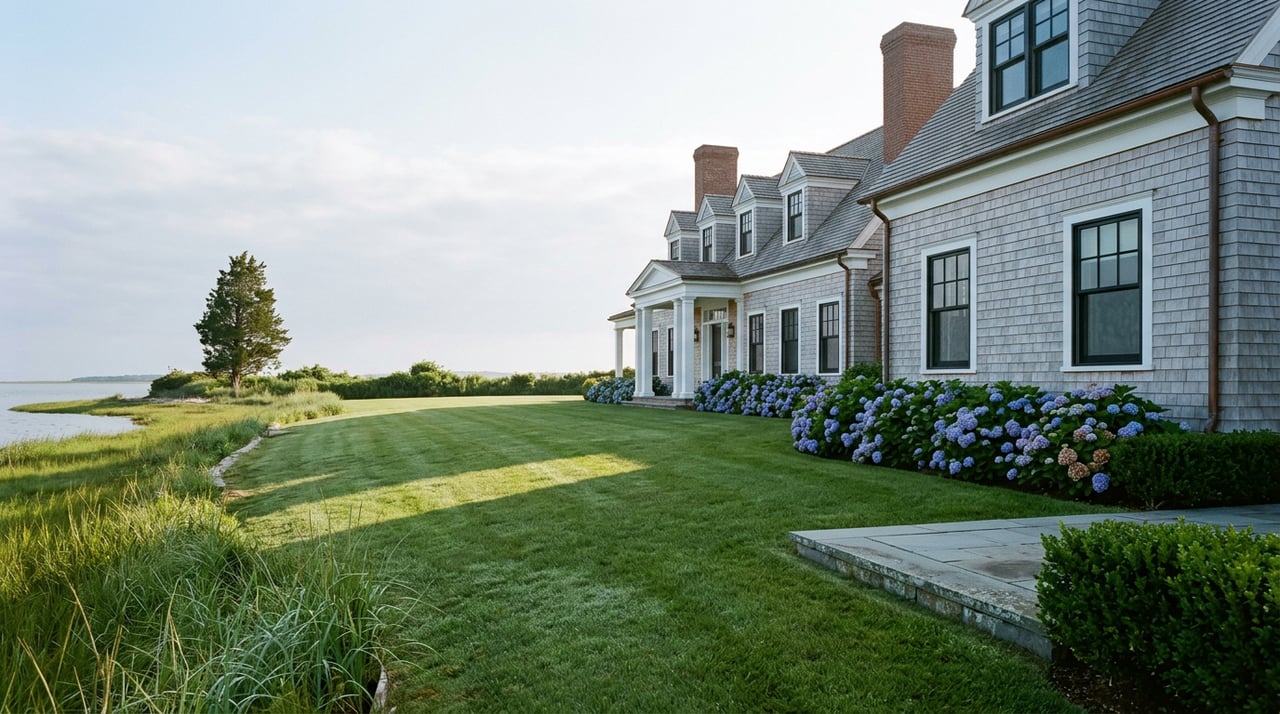
Here is the part that trips people up. The town of Darien provides both permanent and visitor moorings inside the cove, and the water itself is unpolluted enough to support swimming and fishing without restriction. That makes it feel public. It is not. The land ringing the cove, the granite bluffs and marsh and sand that make it so photogenic from the water, belongs to private owners who have never opened it to foot traffic. You can drop anchor. You cannot walk ashore.
That same private ownership extends below the waterline in a way almost nobody boating through the cove would guess. The seabed itself is designated private oyster ground. Sections of it are actively used for commercial oyster seed production, combining a land-based nursery with floating cage structures anchored in the water. Anyone who has ever admired the cove's clear water for its swimming conditions has been admiring, without realizing it, water conditions that also happen to be exactly what a working shellfish operation needs.
Two Economies Sharing the Same Ten Feet of Water
This is the detail that changes how you should think about Ziegler's Cove. It is not simply a pretty anchorage that happens to have some oyster infrastructure nearby. It is running two separate economies on the same small footprint of water, and they operate on completely different calendars.
The recreational economy is loud, seasonal, and visible. It peaks on weekends like this one, when MarineMax's raft-up brings boats in from across Fairfield County and Long Island for an afternoon of rafting, paddling, and sunbathing. The Corinthians Association, a national boating group, has organized informal gatherings at the exact same anchorage, describing it as a spot where boats raft together and visitors trade snacks across the gunwales while swimming conditions stay ideal. This is the version of the cove that shows up in photos, the one that makes Darien's stretch of the Sound feel like a party that started sometime in June and won't fully wind down until the water gets too cold to swim in.
The working economy runs on a completely different schedule and draws zero attention. It doesn't care about weekends. It doesn't need boats rafted up or paddleboards in the water. It needs the seabed left alone long enough for oyster seed to mature in cages that most weekend boaters will never notice are there at all, tucked below a surface full of hulls and life jackets. Two industries, one address, and almost no overlap in who's aware of the other.
What This Actually Means If You Keep a Boat Here
If you are the kind of Darien resident who owns a boat, or is thinking about buying one now that you've settled into a house with water access, the cove's dual identity has practical implications beyond trivia. The town's moorings inside Darien waters carry no annual fee, which is unusual compared to many private marinas along this stretch of coast. There is a fifteen-dollar yearly charge simply to use the town's online mooring registration system, and renewal applications for any mooring space in Darien's waters are due by May 1st each year. Miss that window and you're negotiating for a spot rather than renewing one you already hold.
The private oyster designation matters here too, in a narrower but real way. Moorings inside areas marked as oyster ground require the property owner's permission, not just the town's registration. It's the kind of detail that only surfaces if you actually try to secure a mooring in the wrong stretch of the cove and get told no, rather than something any general boating guide to Long Island Sound would flag.
Why the Overlap Says Something About Darien
What makes Ziegler's Cove worth understanding, rather than just visiting, is what its layered use says about how this town treats its coastline generally. Darien doesn't advertise its working waterfront the way some Connecticut shoreline towns lean into the fishing-village aesthetic. There's no sign at the cove explaining the oyster operation, no marker distinguishing recreational water from working water. The cove simply lets both uses coexist, quietly, the same way Darien tends to let its private beach clubs and its public beaches sit a few hundred yards apart without much fanfare either way.
That quiet layering is part of what makes this stretch of the Gold Coast feel different from towns that market their waterfront harder. The cove isn't performing for anyone. It's simply doing two jobs at once, and most of the people enjoying one of those jobs have no idea the other is happening directly underneath them. If you've boated through Ziegler's Cove more than once and never thought about what's below the waterline, that's not a knowledge gap unique to you. It's built into how the place works.
If you're weighing whether a home with water access, a mooring, or proximity to anchorages like this one fits into your next move in Darien, Stephanie O'Grady has spent a decade working this exact stretch of the Gold Coast and can talk through what waterfront and near-waterfront ownership actually involves here, moorings, access rights, and all. Request a complimentary market consultation to start that conversation.