Most Darien sellers walk into a listing conversation focused on comps and staging. Two weeks later, after a strong contract at or above ask, they lose the negotiation they thought they had already won. The re-trade almost never comes from the appraisal or the financing. It comes from the inspection report, and in this town it tends to come from the same short list of findings every time.
That is the argument here. In a market where Darien's single-family median reached $2.54M in Q1 2026 at a 106.6% sale-to-list ratio, with the $3M–$4M bracket clearing at 111.9% and July 2026 homes selling in a median of 14 days, the premium a seller wins at contract is not locked in. It is on loan until inspection. Which means the meaningful preparation for a Darien sale is not the last cushion or the last shrub. It is the pre-inspection.
The list-price fight is won at the offer. The transaction is won or lost at the inspection.
Where the money actually moves
At 111.9% sale-to-list in the upper tier, the average $3.5M contract closed roughly $400K above ask in Q1. That is the buffer a buyer's inspector is instructed to test. Buyers competing above ask are not walking away over a $6,000 flue liner. They are looking for the one line item that lets them claw back 3% to 5% without losing the house. In Darien, three categories do most of that work: septic, radon, and coastal wear on the envelope. Each carries a Connecticut wrinkle that a buyer's counsel knows and a seller's paperwork often does not.
Septic, and why bedroom count is the sneaky number
Darien's downtown core sits on public sewer, but a meaningful share of the town, including large lots in Tokeneke, Long Neck Point, and Noroton Bay, still runs on private septic. The Darien Health Department is direct about the exposure: a properly installed septic system can last many years, but repair and replacement costs run well into the five figures. That is the headline risk. The subtler one is capacity.
The Health Department publishes a policy tying leaching capacity to bedroom count. A four-bedroom septic on paper does not support a five-bedroom expansion, and it does not always support a five-bedroom listing. Buyers who plan to add a bedroom, finish an attic, or convert a bonus room read that policy carefully. A pre-listing septic inspection is what separates a clean answer from a $60,000 conversation on day fourteen.
What a Connecticut septic inspection actually surfaces:
- Tank access covers must sit within twelve inches of grade under the state health code, per the checklist providers like Suburban Sanitation follow.
- Cesspools, where the tank and leaching share a single pit, are prohibited under the current health code and disqualify some forms of financing.
- Single-compartment tanks let solids reach the leaching field and lead to premature failure.
- Older systems installed below high groundwater levels flood seasonally, which is a coastal-Darien pattern more than an inland one.
None of these are visible on a walkthrough. All of them are visible on a $500 dye-and-camera inspection ordered before the listing goes live.
Radon, and the disclosure line most sellers gloss
Radon is where the CT paperwork does real work. The state's Residential Property Condition Disclosure Report, mandated under Connecticut General Statutes Section 20-327b for any transfer of residential property of four dwelling units or less, includes a direct question: has a test for radon been done, and is a radon control system in place or has one been in place in the previous twelve months. A blank answer is not neutral. A buyer's attorney reads it as a reason to test, and the test itself becomes a negotiation.
Local inspectors confirm the exposure. Radon has been detected in parts of Darien and neighboring towns, and testing is the only way to know a home's levels. A mitigation system in a Darien basement typically runs $1,500 to $2,500 installed. That is not a deal-breaker at any price point in this market. What breaks the deal is discovering it under a fourteen-day inspection contingency, when the buyer is already framing the finding as a reason to renegotiate the whole envelope.
The move for sellers is to test before listing, disclose the result, and where elevated, mitigate and disclose the mitigation. The CT form has a line for it. Use it.
Coastal wear, and the drone the buyer's inspector already brought
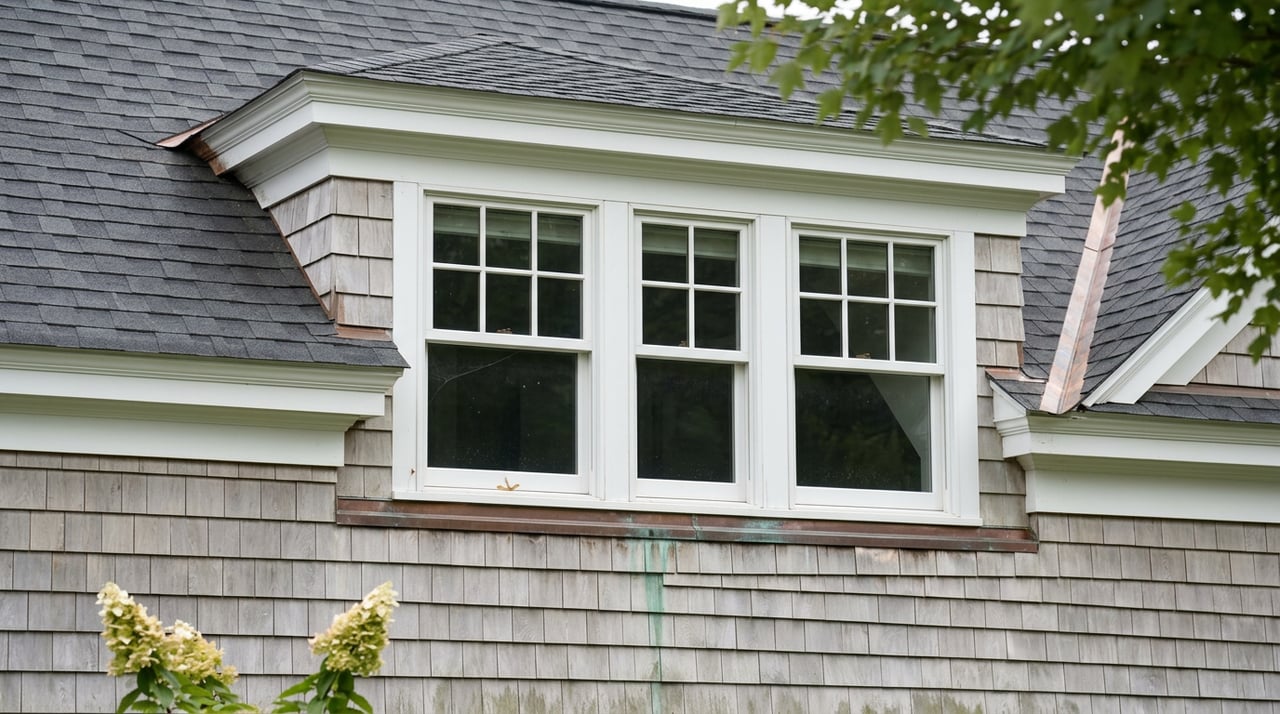
Homes near the water carry a different inspection profile. Coastal homes in Tokeneke, Noroton Bay, and Long Neck Point contend with salt air, storms, and humidity that affect roofs and siding in ways that inland Darien housing stock does not. Cedar shingle sidewalls weather faster on the sound-facing elevation. Copper flashing patinas unevenly and can lift at chimney saddles. Crawl-space humidity readings above 60% show up as elevated moisture calls on the report even when nothing is actively wrong.
The equipment has caught up with the geography. Darien's multi-level and coastal homes often have roofs that are difficult or unsafe to walk, and FAA-licensed drone pilots now capture detailed aerial images of roof conditions and storm damage as part of a standard inspection. A pre-listing drone flyover, added to a standard inspection that typically ranges $475 to $725 depending on add-ons, tells a seller which slope will be flagged and which will not. That is cheap information relative to what a re-trade costs at Darien price points.
What the CT disclosure actually forces into the open
Connecticut is not a buyer-beware state. Sellers cannot remain silent about known problems, and even a defect that is not readily visible must be disclosed if the seller is aware of it. The disclosure report must be delivered before any binder or purchase contract is executed, and a seller who fails to furnish it owes the buyer a $500 credit at closing under CGS Section 20-327c. The $500 is not the real cost. The real cost is the credibility hit when a buyer's attorney learns mid-contract that a known issue was not on the form.
The form itself asks about water quality, well pressure, sewage disposal, structural issues, radon testing, underground fuel tanks, and leased equipment including propane tanks and solar. Every one of those lines is a candidate for a mid-contract re-trade if the seller under-answers. Every one is straightforward to disclose in advance and defuse.
A pre-listing sequence that protects the premium
For a Darien home targeting the $2.5M-and-up band, the sequence that consistently holds the contract premium looks like this:
- Order the septic inspection eight weeks before listing if the home is off sewer. Repair or pump on your own timeline, not the buyer's.
- Run a 48-hour radon test in the lowest livable level. If elevated, install mitigation now and disclose the system on the CT form.
- If the home is within a half mile of the water, budget a drone-assisted roof inspection and pre-address any lifted flashing or displaced ridge caps.
- Confirm every leased item, propane tank, water softener, alarm, and solar array, and gather the contracts. These belong on the disclosure and are among the most common last-week surprises.
- Pull permits for any finished basement, addition, or generator installation. Missing certificates of occupancy show up in title work and delay closings; the state form itself directs buyers to consult the municipal building official to confirm permits and COs were issued.
None of this is glamorous. All of it is cheaper than a post-inspection credit at a 111.9% sale-to-list price point.
Three questions this raises
Does a pre-listing inspection have to be disclosed to buyers?
If it produces a written report and the seller knows the findings, those findings become known defects for purposes of the Connecticut disclosure. That is a reason to fix rather than to skip. A repaired issue disclosed with an invoice is a very different negotiation than an unrepaired one flagged by the buyer's inspector.
Is the $500 credit under Section 20-327c the whole exposure for a missing disclosure?
The statutory credit is $500, but that is not the ceiling on liability. Failure to accurately and adequately disclose known property condition issues can lead to a lawsuit separate from the credit. This is a paperwork item worth taking seriously, not a $500 line item to buy your way out of.
If the home is on public sewer, does any of the septic conversation matter?
For that specific property, no. For the buyer's mental model, yes. Darien buyers coming from Manhattan often do not distinguish between the sewered downtown and the septic pockets until an inspector explains it. Knowing which side of that line your address sits on, and stating it plainly in the listing materials, removes an easy source of buyer anxiety.
Darien's current market rewards sellers who treat the inspection as the real closing, not a formality after it. If you are planning a 2026 sale in the $2.5M-and-up band and want a walkthrough of which findings your specific home is likely to produce, Stephanie O'Grady is available to request a complimentary market consultation and a pre-listing inspection plan tailored to your street, your shoreline exposure, and your buyer pool.